

Showing posts with label #TheWaltDisneyCompany. Show all posts
Showing posts with label #TheWaltDisneyCompany. Show all posts
Friday, October 16, 2020
Wednesday, October 16, 2019
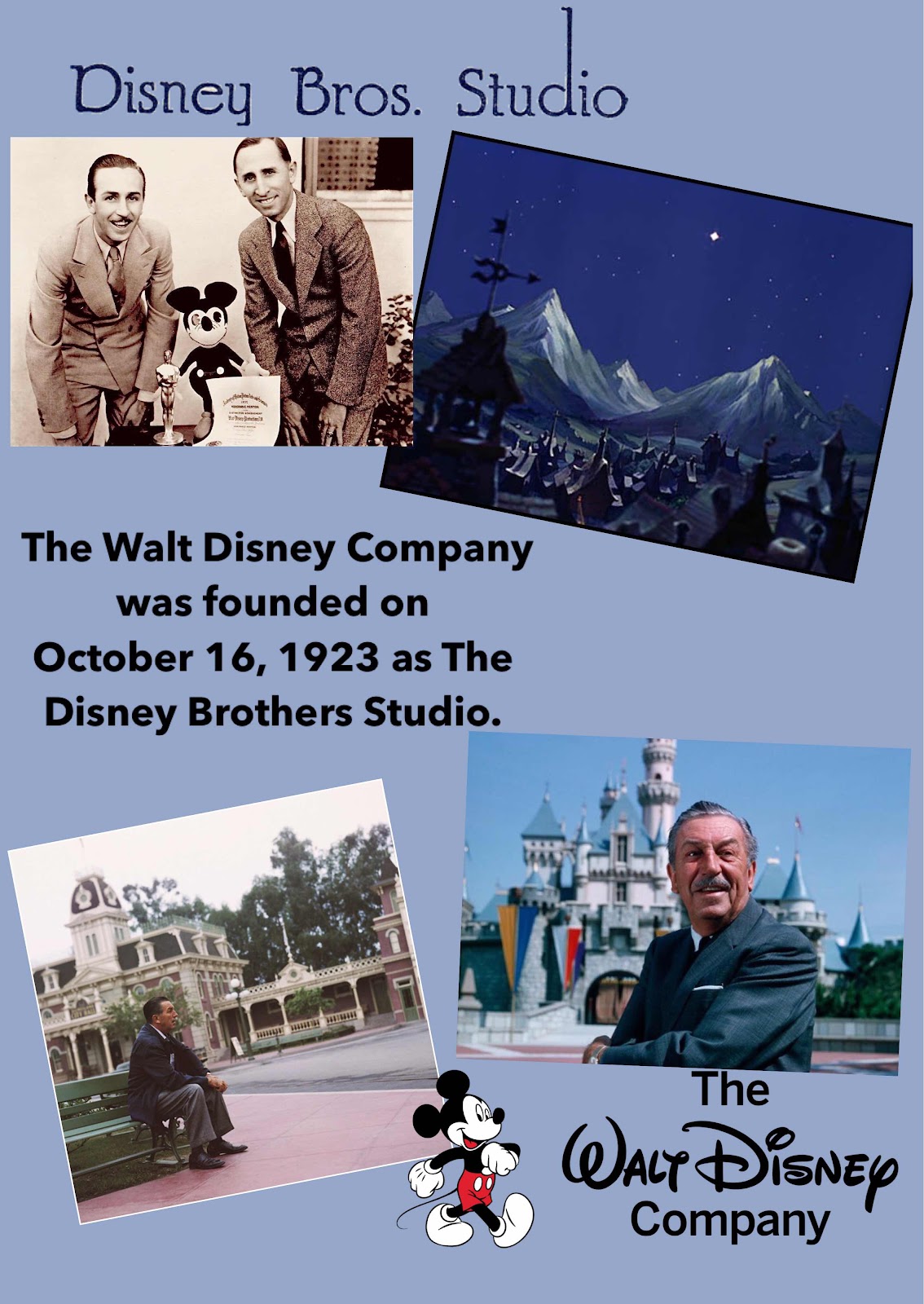
Wednesday, March 20, 2019
Disney Buys Fox
In 1923, Walt Disney arrived in California with $40, a suitcase, a lot of dreams and little else. William Fox, on the other hand, was a multi-millionaire who owned a chain of movie theaters and the Fox Film Corporation.
Most people in 1923, if told that the company established by one of these men would eventually buyout the company established by the other, would have guessed that it was William Fox’s company that would buy Walt Disney’s company. Of course, today we know it was the opposite. Walt Disney’s Company grew exponentially, making his name known throughout the world. Today, Twentieth Century Fox becomes part of The Walt Disney Company- because anything can be done with just one dream.

Tuesday, March 19, 2019
Disney Closes the Deal With Fox
The Walt Disney Company officially took over 20th Century Fox at 9PM PDT. Welcome aboard!
Friday, February 15, 2019
Dave Smith, 1940 - 2019
Dave Smith, the pre-eminent Disney historian and archivist has passed away.

Mr. Smith joined The Walt Disney Company purely by accident. He was working on a college project and asked for permission to view the company archives. He received a call from a puzzled Disney executive who wondered why he’d want to look through a bunch of old papers. Dave would later discover that the puzzled executive was none other than Roy Disney. Dave was shocked at how seemingly priceless articles were being kept in random boxes and in basements around the studio.
After completing his project, he made a presentation to Roy about how the company could profit from a more organized and formal archive. Roy Disney hired him on the spot and Dave began collecting and categorizing the company’s treasures. The resources within the archives have proven to be a treasure for the company, providing assistance in making new pictures like Mary Poppins Returns, designing merchandise and restoring films.
Dave wrote many books about Disney and was just as excited about the company as its fans. His passion for all things Disney saved many priceless items from being thrown out and a wealth of treasures. I had the pleasure of meeting him at several Disney events and chatting with him online in the early days of the internet. He was always friendly and willing to share his vast knowledge with Disney’s biggest fans. It is doubtful that this website and many others like it would exist without his hard work and dedication. Thank you for preserving Disney history, Mr. Smith and enjoy your eternal rest.
Wednesday, August 8, 2018
Walt Wednesdays: A Brotherly Business
When Walt Disney signed his first contract to produce his Alice Comedies in 1923, the first person he ran to was his brother Roy. Roy had been convalescing in an army hospital after World War I because he had contracted tuberculosis. After hearing that his kid brother needed him, he checked himself out of the hospital and the two brothers setup the Disney Brothers Studio.


As time went on, and the studio’s fortunes grew ever brighter, a studio publicist advised the two that they should either rename their company after just one of the brothers or give it a more generic name. It was felt that using just one of their names would make it easier to promote the studio’s films. As the creative mind behind the company’s productions, it was decided to rename the company “Walt Disney Productions,” though Roy would still hold an equal number of shares in the company.

Despite the implications behind this decision, Roy was not upset or jealous of his brother’s ascension as the public face of the company. Roy wasn’t really interested in the Hollywood scene; he probably would have teamed up with his brother even if he had planned to open a box factory. Roy enjoyed the business side of things and spent his time keeping Walt under budget and finding money to continue making and building his brother’s dreams.

While the partnership often went through rough patches- Roy was never fully onboard with the idea of DISNEYLAND and Walt had to get his brother out of the country in order to get the Matterhorn built- their fondness and love for one another seemingly conquered all. Whether it was protecting his brother from bullies or financing a Magic Kingdom, Roy was always there when his brother needed him. A successful partnership indeed.
Friday, August 3, 2018
Disney & Fox Week: Then & Now
In the 1950’s, the rise of television cast a pall on Hollywood. While most studios now produce both theatrical films and television programming, that wasn’t the case in the beginning. When Walt Disney embraced television as a way to help finance DISNEYLAND, he was seen as a traitor. He saw it as a way to diversify.

The decision to build DISNEYLAND not only allowed Mr. Disney to diversify, it arguably allowed his company to survive until today. DISNEYLAND Park has provided the company the stability it has needed throughout the years. The company also branched out into live action pictures which could be produced more cheaply and quickly than animated films.

Walt Disney also tried to keep his best friend Mickey Mouse relevant by creating The Mickey Mouse Club, which became a phenomenon for the baby boomers. The show also produced a superstar- Annette Funicello. At a time when other studios struggled in a post-TV era, Disney was firing on all cylinders. Every kid wanted to visit DISNEYLAND and see the latest Disney movies.

Even after the death of its founder, the solid foundation laid by Mr. Disney allowed it to thrive. Though it didn’t quite end up the way he’d planned, “Disneyland East” opened up in 1972 as Walt Disney World, financed by the profits earned at DISNEYLAND. This further diversification would keep the company afloat during the lean years ahead.

While the studio would be stymied by its reluctance to evolve in the 1970’s, Walt Disney’s efforts at diversification allowed the company to weather the leaner years. By the time the go-go 1980’s arrived, Disney was ready to grow. It would diversify into more mature pictures through Touchstone Pictures, buy the ABC television network and begin expanding its resorts.

By the time that DISNEYLAND celebrated its 60th Anniversary, the company would own Lucasfilm and Marvel, two powerhouses in the current movie industry. The sleeping giant of the 1970’s was now a massive behemoth, capable of making an offer for Twentieth Century Fox.
Back in the 1950’s, however, Twentieth Century Fox originally chose not to diversify. It chose to compete with television by making bigger and more expensive films. Large spectacles were a difficult prospect in Hollywood’s Golden Days. They were especially problematic in an era where a movie theater’s biggest competitor was free television. Things went mostly well for the studio until it crossed paths with Cleopatra.

Cleopatra almost singlehandedly destroyed Twentieth Century Fox. The film would star Elizabeth Taylor who was a constant problem from the very beginning. After she took ill just a few weeks into the shoot, she was ordered to bed rest. Fox was forced to flush away $2,000,000 with no usable footage to show for it. By the time Ms. Taylor was feeling better, the studio had to rebuild sets and reschedule studio time at huge expense. Ms. Taylor’s contract stipulated that Chasen’s famous chili be flown out to the set no matter where she was in the world. The temperamental actress’ sizzling affair with Richard Burton scandalized potential audiences and sent the budget into the stratosphere. Adjusted for inflation, the film cost a staggering $370 Million. While it made a bit more than that at the box office, its high production and promotional costs made Fox suffer an almost insurmountable loss.

A power struggle between Darryl Zanuck and his son Richard boiled over after Cleopatra’s staggering loss. The younger Zanuck insisted that the project’s failure was a sign that his father was past his prime. In order to recover, the studio sold off most of its storied backlot, creating Century City. Money problems also forced the studio to finally diversify into television. Robert Zanuck chose to move the studio into the modern era by producing ‘today’ pictures for the youth of the day. These types of films could be produced much more cheaply than the spectacles favored by his father and offer nudity and profanity, which television couldn’t touch.

While some of the films were successful and spawned lucrative spinoffs- like M*A*S*H- there were too many flops like Myra Breckinridge which embarrassed the studio. By 1972, the Zanuck era had ended with both Zanuck’s ousted from the studio. The new studio management had greater success with the colossal Star Wars becoming a smash hit. Unfortunately for the studio, it had given merchandise rights to George Lucas who planned to use the licensing fees to finish up the special effects. Fox had assumed the merchandise rights would be valueless. Of course, they weren’t and George Lucas used the lucrative side money to purchase the Star Wars copyrights.

It was during the 1980’s (and under the ownership of Rupert Murdoch) that the company went all-in on television, setting up its own upstart television network. At first, not much of its programming gained any traction, but rather than give in the network stayed the course, getting its first big hit- Married With Children. As the 1990’s began, it got its most lucrative hit ever- The Simpsons, who brought the younger audience that the network craved and became a merchandising juggernaut.

A political conservative, Fox owner Rupert Murdoch used the Fox name to launch a conservative news channel. While the channel itself became successful, it severely tarnished the company’s brand and its reputation in Hollywood. While most of the company’s biggest successes were in television, it remained competitive in motion pictures, restarting the age of superheroes with its successful X-Men films, licensed from Marvel Comics.

While the studio has mostly flourished, the Murdochs seemed less and less interested in it. They realized that in order to compete in the future, Twentieth Century Fox would need to either buy another studio or sell itself to another studio. Thus it agreed to be purchased by The Walt Disney Company.
Could Walt Disney have possibly imagined that the company he founded in 1923 with his brother would eventually be able to buy Twentieth Century Fox? After all, in 1923 he had just $40, a suitcase and a Dream. William Fox was a multi-millionaire, controlling a vast network of theaters and one of Hollywood’s biggest studios. If anything, one might have assumed that it would be William Fox’s company doing the buying. Fate and luck would eventually prove otherwise. A suitcase and a Dream might not be enough to get you where you’re going, but they can be a great start.
Thursday, August 2, 2018
Disney & Fox Week: On the Move
As the 1930’s began, the Fox Film Corporation, having removed its founder, was in turmoil. While its various businesses were mostly viable, it was still in receivership and its prospects were grim. Meanwhile, Louis B. Mayer, having firmly ensconced himself at the top of MGM, was looking for a job for his son-in-law. At the same time, Darryl F. Zanuck and Joseph Schenck were getting restless at United Artists. Despite their contributions to the studio, the pair were treated as second class citizens by the studio’s actor/owners. With backing and investment from Louis B. Mayer, and, initially, United Artists, 20th Century Films was founded in 1933. With its ability to draw from MGM’s stable of actors and distribution by United Artists, 20th Century aimed to be a powerhouse in Hollywood.

Joseph Schenck and Darryl Zanuck
The shaky partnership, however, began to go off the rails fairly quickly. Despite the studio’s stellar track record- only one of its first twenty projects failed to make a profit- Schenck and Zanuck felt that United Artists was not paying the same attention to 20th Century’s films as it did its own. Since the studio employed Louis B. Mayer’s son in law, relations between it and MGM were more cordial, though the two movie moguls felt that they could never achieve the great heights they aspired to by standing in Louis B. Mayer’s shadow. They needed their own distribution network and theater chain- and they needed it as soon as possible.

Meanwhile, the team brought in by the receiver to turn around Fox Film Corporation realized that the business could not be salvaged on its own. The company had the infrastructure, but much of its talent had jumped ship to avoid its turmoil. Soon the idea of a possible merger or sale was being floated around. Schenck and Zanuck seized the opportunity. Fox needed capital and talent, which 20th Century had in abundance. 20th Century needed a distribution infrastructure and theater chain, which Fox had. It was a match made in heaven. The two companies merged at first to become Fox-20th Century. Cooler heads prevailed and the much better name of 20th Century-Fox was chosen.

The studio quickly continued its successful run. Freed from their previous constraints, Darryl Zanuck and Joseph Schenck built the studio’s roster, signing bright new talent. Their biggest discovery was a pint sized dynamo named Shirley Temple. Her bright eyes and positive attitude were just what the depression-era world needed. No longer standing in the shadow of MGM or United Artists, Fox had become a powerhouse. Its historical biographies and musicals were huge moneymakers. As the depression and then the war loomed, Fox’s bubbly musicals helped it surpass MGM, United Artists and RKO at the box office.

Problems soon began sprouting up, however. Joseph Schenck would get convicted of tax evasion and serve time in prison. The Justice Department had ordered the studio to divest from its movie theater chain and the biggest problem of all would be the advent of television. Whereas other studios tried to economize or diversify, 20th Century Fox doubled down. It would compete with television by offering the giant spectacles that television couldn’t compete with. These larger productions would require larger budgets and larger returns. If this gambit worked, the studio would be handsomely rewarded. If it didn’t- well, that’s a story for next time.

Meanwhile, Walt Disney was slowly but surely building his empire. Mickey Mouse was doing gangbuster business. Despite the depression, audiences lined up around the block to watch the latest Mickey Mouse cartoons. Walt Disney Productions became one of the first Hollywood studios to take advantage of licensing merchandise. Mickey Mouse’s draw was so immense, he singlehandedly saved both Timex and Lionel. Walt Disney, however, was spending increasingly larger amounts of cash to produce his films, straining both his finances and his relationship with his brother.

Walt Disney, however, was trying to diversify. His Silly Symphonies cartoons featured more realistic animation and more detailed backgrounds than the Mickey Mouse shorts. While the varied shorts were often a hard sell, one of them rivaled Mickey Mouse’s popularity- The Three Little Pigs. All of this would be a rehearsal of sorts for Walt Disney’s biggest gamble- Snow White and the Seven Dwarfs. The feature length animated film had been dubbed ‘Walt’s Folly’ but its massive box office receipts allowed the studio to expand and grow.

Right when things seemed brightest, the shadow of war appeared. The Walt Disney Studios, more so than any other in Hollywood, had been deeply affected by the war. The huge lead time for animation meant that several expensive pictures were in production when war was declared. While live action productions could be quickly curtailed or downsized, animated ones could not. Pinocchio and Fantasia premiered to a changed world where most foreign markets were closed off to Hollywood for now. The U.S. military took over Walt Disney Studios and the studio soon found itself working on war related films.

Feature film production had ceased and the studio found itself under reduced circumstances. A painful strike added more problems for the studio. Whereas the other studios found the war to be okay for business, that wasn’t true for Disney. The studio was seen as being severely weakened after the war. It wouldn’t have surprised most people if it didn’t survive long into the television era. Taking children to the movies was always an iffy proposition. Television seemed tailor made for kids. How could Disney survive in the television age? Walt Disney would choose to diversify.
Wednesday, August 1, 2018
Disney & Fox Week: Changing Fates
When the 1920’s began, William Fox was sitting on top when it came to the motion picture business, while Walt Disney was even in Southern California yet. William Fox was steadily building his empire as the years went by, acquiring other motion picture producers, like Movietone, and expanding his theater chain. His biggest opportunity came about because of the death of another theater titan, though trying to take advantage of it ended up ruining his show business career.

Marcus Loew was a theater Titan who had built up a massive chain of theaters. After purchasing Metro Pictures, he lamented the lack of quality found in their films, so he purchased Goldwyn Pictures to improve their quality. After the film industry moved west, he decided he needed a strong executive in California to keep things moving forward. Thus he bought Mayer Pictures and brought in Louis B. Mayer to operate things in California. This shotgun marriage resulted in the new film behemoth- Metro-Goldwyn-Mayer, better known as MGM. Mr. Loew’s run atop his new empire would be sadly short lived; he passed away just a few years later. Loew’s Family was uninterested in operating his empire, so when William Fox approached them about purchasing it, they willingly agreed. While this might have been seen as the beginning of big things by Mr. Fox, it would end up becoming the beginning of the end.

The deal between the Loew family and William Fox caught the ire of Louis B. Mayer. Mayer had wanted to make a deal himself and hadn’t been given the opportunity. He refused to work for William Fox and declared all out war against him. Not one to back down, Fox steeled himself for a long fight. Unfortunately for him, he would be in a car accident in which he’d been blamed. No longer at his best, Fox still planned to fight for control of Loews until the Great Depression dealt a fatal blow; William Fox was financially ruined. Not only did Louis B. Mayer triumph in the fight for MGM, Mr. Fox would lose the studio that bore his name.

Meanwhile, Walt Disney had joined forces with his brother and produced the amiable Alice Comedies for MJ Winkler and Carl Laemmle’s Universal Pictures. The shorts were nice enough, but they didn’t set the world on fire and Walt Disney’s desire for perfection made them expensive to produce. By the mid 1920’s, Walt, Ms. Winkler and Carl Laemmle we’re ready to move on. Walt Disney chose his next big project- short cartoons featuring an all new character- Oswald the Lucky Rabbit. Oswald was a rambunctious Rabbit who often found himself in precarious situations that were of his own making. The Rabbit was a huge success, quickly becoming one of Universal’s biggest draws. An unfortunate reversal of fortune lay ahead, however.

Universal and Charles Mintz, who had taken over his wife’s (Margaret Winkler) production company, had grown increasingly upset at Walt Disney’s high costs. They wanted to eliminate him as a middleman, so Walt was summoned to Winkler’s New York offices while Universal poached his animators in Los Angeles. Mintz offered Walt an ultimatum; make the films for half the price or say goodbye to his animators and character. Since Walt Disney had signed all rights over to Universal, he was powerless to stop it. He gave in and took a long train ride back out to California with his wife. By the time they arrived in Los Angeles, Walt Disney had a new character and a new outlook on life.

Mickey Mouse would be a sensation- 100x more popular than Oswald ever was- or ever would be. America and the world would fall in love with this spunky little mouse, providing Walt Disney with success beyond his wildest dreams. Even the Great Depression couldn’t dampen Mickey’s popularity. His can-do attitude and belief that there was always a great big beautiful tomorrow just a Dream Away made him irresistible to depression era audiences.
The 1920’s ended with Disney and Fox in dramatically different places than when the decade began. Walt Disney started out the decade livingvin obscurity and struggling to get something going. By 1929, he had nothing but blue skies ahead as Mickey Mouse conquered the world. William Fox, on the other hand, began the decade as a motion picture mogul on the rise and ended it a ruined man. How would the company he founded fare without him at the helm? How would it survive until the present day? The story continues tomorrow.
Tuesday, July 31, 2018
Disney & Fox Week: 1923
When we last left off, it was 1923 and William Fox was expanding his empire while Walt Disney was barely eking out an existence. In any case, Fox was already well established in show business while Disney was trying to start up something- Anything.

While we can’t definitively say that Walt Disney had visited Fox to try to sell his first project- the Alice Comedies- he most likely did just that; after all, he was trying to drum up interest in his project everywhere he could. If such a meeting ever took place, it is doubtful that the Fox representatives present would have ever thought that this rumpled, fresh off the train Midwesterner would ever found a company that would eventually buy theirs. They probably couldn’t even have imagined that their company would ever be interested in buying anything he had to sell.

Walt Disney’s 1923 “Studio”

William Fox’s 1923 Studio
Eventually Walt Disney’s project would find a home with Margaret Winkler’s entertainment operation which was closely aligned with Universal Pictures. His trajectory was on the rise. Amazingly, William Fox’s fortunes would take the opposite course and he’d find himself on the outside of Hollywood looking in. Neither man knew it yet, but Walt Disney would soon soar while William Fox would take a catastrophic hit to his career courtesy of Louis B. Mayer.
Monday, July 30, 2018
Disney & Fox Week: Two Different Worlds

Last Friday the shareholders of both The Walt Disney Company and 21st Century Fox voted to approve a deal in which The Walt Disney Company will purchase most of 21st Century Fox. The mega deal surprised many in Hollywood, who believed that current majority 21st Century Fox owner Rupert Murdoch would never sell the studio to anyone. This week we’ll take a look at the history of both studios and examine their respective paths to this momentous deal.

William Fox
William Fox was an immigrant from Hungary who came from an entrepreneurial background. He had formed his first company in 1900- a year before Walt Disney was born- but quickly sold it to purchase a nickelodeon, which was the precursor to movie theaters. For the next ten years he would build his company which eventually got into the movie theater business itself. It would be Mr. Fox’s difficulty in finding adequate product for his theaters that would lead him to setup his own movie studio- The Fox Film Corporation- in 1915. Originally established in New Jersey, the studio would join the show business exodus to Southern California in 1917, setting up a state of the art studio in Los Angeles.

Walt Disney was born in Chicago, Illinois to a family that struggled to make ends meet. His father was constantly starting up new businesses but none of them were ever really successful. It seemed that Walt would follow in his footsteps. His first enterprise- Laugh-o-Grams Films- which aimed to make cartoons for advertisers and local movie theaters had filed for bankruptcy. Walt was left with just $40 and the original negative to a live action/cartoon hybrid film that he wanted to turn into a series. With just these few items, Walt Disney hopped onto a train and headed out to Southern California to follow his dreams.
Subscribe to:
Posts (Atom)